"A Garden Against All Odds" – Mohamed Salem Mohamed Ali and Beatrice Galilee in conversation
During a preview screening of The World Around’s Young Climate Stories, Mohamed Salem Mohamed Ali shares the story of building his Nomad Garden in the Algerian Sahara.

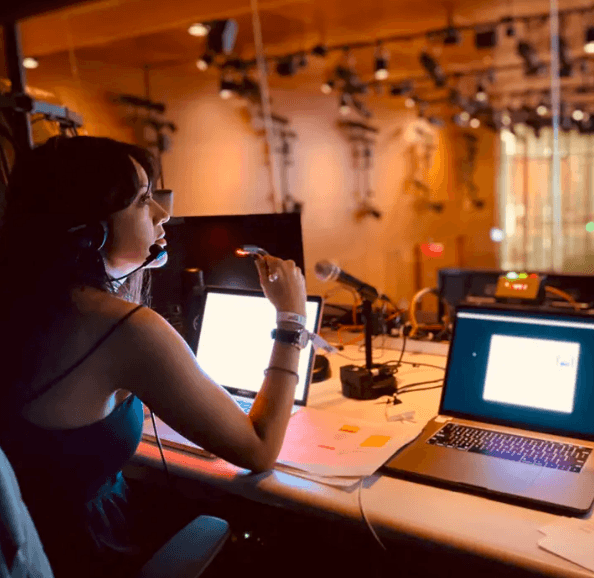
Mohamed Salem Mohamed Ali and Beatrice Galilee in conversation during the Young Climate Stories screening at the MillerKnoll NYC flagship. Photo by Paul Maffi.
Mohamed Salem Mohamed Ali emerged as one of the most compelling voices from Cycle 02 of The World Around Young Climate Prize. While living as a refugee in the Sahrawi camp in Algeria, he has built a thriving garden that grows vegetables and herbs, supports animals like ducks and fish, and recycles water through a complex system of pipes and troughs. The project, which earned Ali the Young Climate Visionary award, is the first to feature in a series of films that The World Around and MillerKnoll have produced to document the extraordinary young people and projects that the prize supports.
On November 13, 2025, a private screening for the film’s premiere took place at MillerKnoll’s New York flagship, followed by a conversation between Ali and The World Around executive director Beatrice Galilee, described how the Nomad Garden began as a practical response to displacement and limited resources before evolving into a broader investigation of water scarcity, sustainable agriculture, and desert-based innovation. By documenting the garden on film, he found both a language to share his work and an unexpected global audience, further expanded through the Young Climate Prize’s mentorship and creative network.

A mint plant grows in the extreme heat of the Sahara in a still from the documentary. Courtesy of CG Foisy.
Beatrice Galilee: You mentioned in the film that the garden started as a hobby. What made you first start planting and gardening? Can you share a little bit about those first moments?
Mohamed Salem Mohamed Ali: When I started the garden in 2018, I was helping my family construct our house, because we were building with mud bricks. Every strong rain we have destroys the house and we need to rebuild it. I wanted to help my family with the construction, and at the same time I was going to an English course, which was an hour and a half per day. No one wanted to hire me for a job if I had an hour and a half off in the morning.
So I decided to keep studying English and not look for another job. We had this little space next to our house where the old house had collapsed, and that’s where I made the small garden. It was a small space turned into rows with vegetables and herbs. I made some small squares of mint and coriander.
It was just a tiny business to sell in the market, to support the garden financially. That’s how I started the Nomad Garden.
BG: When did you start to get recognition? I remember you told me that you made a film about this Nomad Garden. When did you start to think, “I need to tell the story of this garden?”
MS: After I had spent a couple of years working in the garden, I started to see things differently. When I first began, not many people believed in me, especially my friends, who made fun of me. But I accepted that.
A couple of years in, I realized that, just a few years earlier, we all had a very basic view of agriculture: you put seeds in the ground, water them, and that’s it. But when I spent more time in the garden, I learned it’s not just like that. So I wanted to share this with my people, with my community. I wanted to share with them the story and what was happening in the garden.
BG: When you shared in the Young Climate Stories video that it only rains every five years in the camp, it was a powerful moment. With water arriving in limited monthly allocations, how has that shaped your relationship to water and your sense of responsibility toward it?
MS: In the refugee camps, we have a water distribution system. Internationally, the minimum amount of water per person is 20 liters per day. In the camps, if everything goes well—if the trucks are not broken and the filtration system is working—we have around 12 to 16 liters per person per day. That’s maybe not even enough to take a shower.
When you have such a small amount of water, you want to make sure you use it as much as possible. So I wanted to make sure to reuse every drop of water that goes into the garden several times, until it either evaporates or goes to the trees.
BG: The film you made about the garden was shown at a film festival in Algeria, and I understand that other refugees in other camps also have learned about the Nomad Garden. How has the story spreading changed your view of the garden and what you do there?
MS: When I started the garden, I was documenting the process by taking pictures. I didn’t write, because I think we are an oral culture. All the knowledge my parents had was what they were told by their parents or their friends. So I thought it would be a good opportunity to tell my story through film.
I began documenting everything—every experiment, every process in the garden. At first, it was for local people, to show them what was going on, how successful it was. But it also has an international message, because the world is more connected than we think.
For example, industrial agriculture has consequences. What people might see are things like the extraction of natural resources or chemicals going into underground water. But there are other consequences they don’t see. My films try to highlight at least one of the stories happening in other parts of the world because of certain actions.
“Through design, I learned an important lesson: sometimes you have to take time to see everything around you—how it works without you, and how it will work when you enter the system.”
BG: Talking a little bit about that community, maybe we can talk about the Young Climate Prize, which became a way for you to meet other young people who are not necessarily in similar situations, but who share your values. How did you first hear about the prize, and what made you apply?
MS: A friend of mine sent me the link. I went through it, and honestly, I didn’t think it was real. I applied anyway. When I got shortlisted for the first interview, it was really hot in the camps, around 48 to 50°C. The interview was at 4pm. We didn’t have good internet in my house, so we needed to go outside the camp, to a place in the desert where there’s nothing but good internet. But I couldn’t do the interview there.
So I went to the nearest town, which is about 47km from my camp. I did the interview, and that’s when I met Beatrice. Then I got shortlisted again, and later I received the email. I kept reading it again and again because I didn’t think it was real. I thought, “There are so many interesting stories, how are they interested in this little project?”
It was really important to meet other young people, my age, with different stories and different backgrounds. At that time, I needed something to motivate me.
BG: Can you share a little bit about those first meetings, what you remember about meeting the cohort, and what has stayed with you?
MS: I couldn’t make it to the first meeting because I had borrowed my friend’s Wi-Fi and brought it to my house, but it didn’t work. So I missed the introduction of all the other participants. Then I went outside the camp again, to the good internet spot in the desert, and I started searching for these people online. I was really amazed. I wished that we could have a full session for each person, just to hear their stories. That felt very motivational for me.
Then I got my mentor, Brendan McGetrick.
What I like about art is that artists are not just entertainers; they are discoverers, explorers. That’s what I’m doing in the garden: I’m discovering, looking, searching. I had questions about art and what it means, because back home we have a traditional view of art—an artist is a singer or a painter.
So I was curious about art, and I had more questions than answers. When I was told the name of my mentor, I searched him and saw that he was a curator at a museum. I hadn’t been to a museum before. I was really excited. I remember the first sessions were about art and design, and that’s when I was first introduced to design. I remember asking, “What is design?” And he said, “Design is everything, it’s everywhere. Everything you are doing is design.”
I was kind of shocked, because in the garden I am always changing the places of the animals’ houses, the systems; everything is connected. I started to think, “Oh my God, this is the missing piece of the puzzle.”
As a designer, thinking is a big part of the process: you think about the place, the shape, the function, the color, everything matters. I’m really glad I had Brendan as a mentor, and I’m really thankful to The World Around for making such connections.

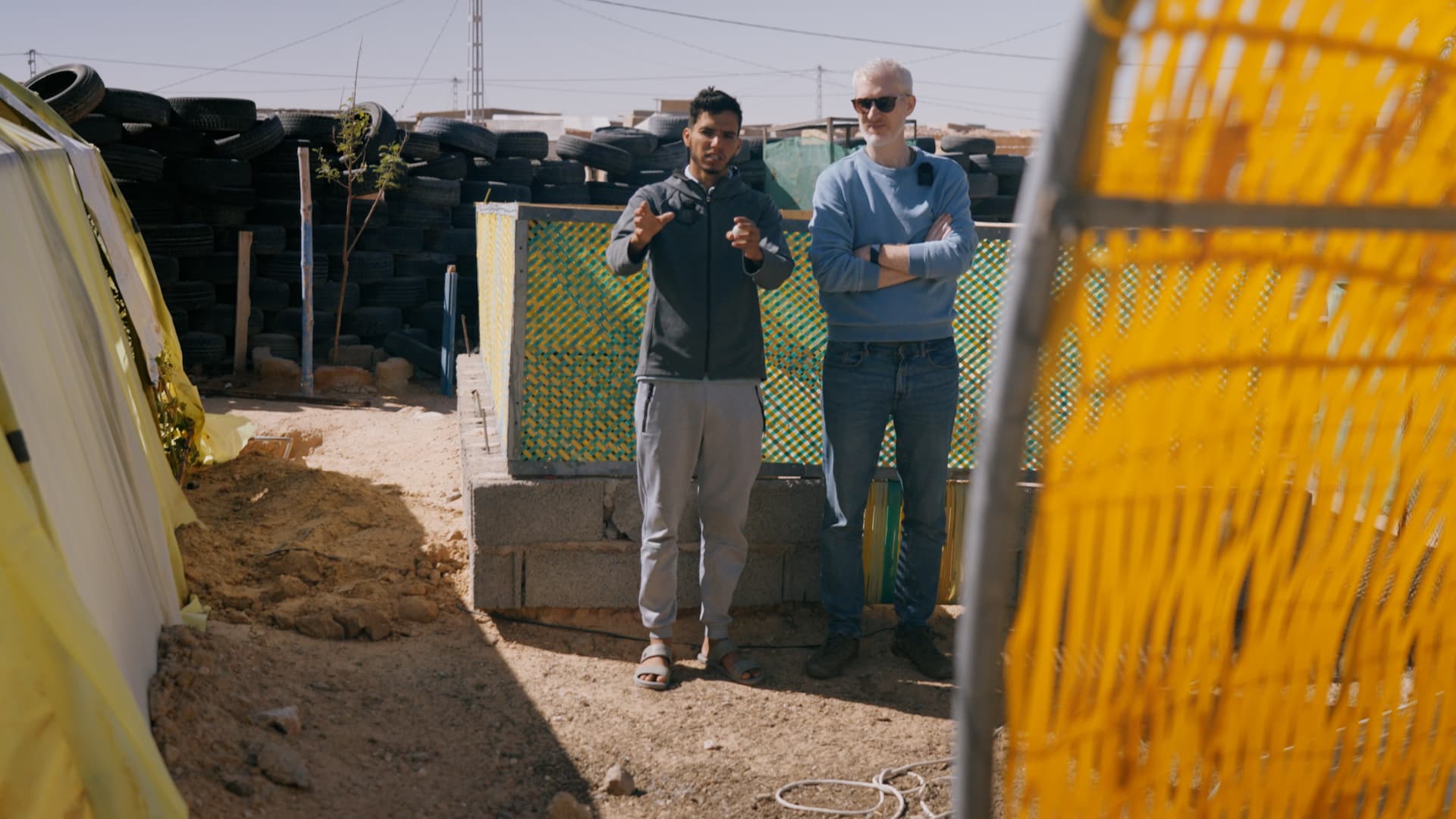
Mohamed Salem Mohamed Ali and his mentor, Brendan McGetrick, in a still from the documentary. Courtesy of CG Foisy.
BG: What were those conversations like? Do you feel that your relationship with Brendan changed when he came to visit?
MS: To be honest, I felt more comfortable meeting him face to face, because I’m not used to online meetings. When I met him in person, I had more time to ask questions. It was really nice to meet him.
He helped with the design and everything, but he was also the first mentor I ever had. That makes this a very special relationship for me—one I’m going to remember for my whole life. I think it was a life-changing point for me.
BG: What message would you like everyone to leave this event with?
MS: I have a very old friend who lived a fully nomadic life. I always like to listen to his stories. I spend a lot of time with him, listening to how they survived in the desert and how they used to move to find food. I actually recorded everything as an archive.
When I learn something new in the garden—something that’s good for the environment, like minimalism, for example—I go straight to him to tell him about it. I say, “Do you know what I learned today? I learned something called minimalism. Minimalism is having as few things as you possibly can,” and I explain it. When I finish, he says, “From your description, we were minimalists.”
Another day I’ll come with something else: “I learned today something called zero-waste lifestyle.” And he’ll say, “We didn’t know plastic before we came to the camps. We were living like that already.”
It turns out they were living sustainably. They didn’t have a term for it; they were just doing it. We are the ones giving names to everything while often doing the opposite.
So one thing that might be good is to learn from Indigenous people. And another thing to consider is that what really matters is actions, not names.
Audience: Where are you trying to take the garden in the next five years?
MS: The Nomad Garden came from the nomadic lifestyle. I want to create a truly nomadic garden, with all the systems built on wagons so we can pull them wherever we go. It’s not just about the Sahrawi lifestyle. We live in the desert, and it has its own animals and its own life. I don’t think we have the right to create huge, massive farms in the desert. It’s better to work on a small scale.
Recently, I read a NASA study that showed 22,000 tons of phosphate travel annually with the sand wind to the Amazon to fertilize the land. Maybe we are responsible for this desert and should leave it as it is. So the garden is an experimental garden. We are always learning and exploring, with successful and unsuccessful experiments. That’s how we’re building knowledge. I honestly don’t know where we will be five years from now.
Audience: What was the biggest lesson that you have carried over from the garden into your life?
MS: When I’m working in the garden, I used to listen to podcasts to learn English. A couple of years later, when my English improved, I started just thinking while I worked.
I learned that reflection is very important. Now, I sometimes spend one or two hours just sitting in the garden, looking at everything around me.
Through design, I learned this important lesson: sometimes you have to take time to see everything around you—how it works without you, and how it will work when you enter the system.
The World Around presents Young Climate Stories
A 4Hawk Production
Made possible by MillerKnoll
Young Climate Stories is a documentary series that follows the young people at the forefront of climate action. Each short film in the series centers a different participant from the second cycle of the Young Climate Prize, exploring how the next generation is working to build a livable, equitable, and sustainable future. Alongside their mentors, these young innovators bring into focus the urgency of the climate crisis and share how they are using their voices, ideas, and designs to reimagine what's possible for communities and the planet.
%252013.04.16.png&w=3840&q=75)
LyntonPepper.jpeg&w=3840&q=75)