“Birds are the best bridge for discussing why the environment matters”
Young Climate Prize alumnus Karinne Tennenbaum is leading a national youth birding movement while pursuing research on partial migration patterns. She discusses the importance of birds in relation to the climate crisis in this interview.
By Ana Minujin
%2520Projects%2520Images%25202%2520(1).png%3F2026-02-11T17%3A51%3A02.136Z&w=3840&q=85)
Taking Flight is an educational initiative to inspire the next generation of climate leaders by fostering an environmental ethic among youth through the magic of birding. Photo courtesy of Karinne Tennenbaum
For biologist and climate advocate Karinne Tennenbaum, birds are more than a subject of study; they are a gateway into understanding migration, community, and collective action. As a finalist of The World Around’s Young Climate Prize Cycle 02, Tennenbaum has continued to expand her work beyond the program, building youth birding networks across the United States while pursuing research on the mysteries of partial migration. She is also the founder and executive director of Taking Flight, an educational initiative that inspires the next generation of climate leaders by fostering environmental stewardship among youth through birding. In conversation with Ana Minujin, Tennenbaum discusses the development of her creative public projects, nationwide organizing, and upcoming fieldwork that will take her from New Haven to Tasmania and beyond. Read an edited version of the interview transcript below.

Young Birders United (YBU) is Taking Flight’s most ambitious project yet. Photo courtesy of Karinne Tennenbaum
Ana Minujin: What first drew you to birds, and what continues to hold your attention?
Karinne Tennenbaum: I started in second grade. There was a science olympiad activity where they taught us about birds in an arboretum, and I really liked it. I liked the color differentiation and the behavior component. I always joke that I really wanted to fly as a kid and my mom was like, “You can’t.” I didn’t want to be a pilot, so the next best thing was to study birds.
Birds are charismatic and accessible. Most people can set up a bird feeder. They watch them, notice them, and don’t know much about them. Compared to bats or lizards, bird people have an easier job getting people interested.
Birds are found all over the world. They are diverse. People find birds that excite them. Kids will say, “I’m a raptor person,” or “I’m into water birds.” People flock—excuse the pun—to Pokémon for the same reason: differences, and something personal to connect with. Birds are the best bridge if you want to talk about why the environment matters when it can feel abstract and far away.
AM: Could you explain what Young Birders United is, and what you have accomplished so far?
KT: Fewer than half of the US states have active young birder chapters. Young Birders United (YBU) is Taking Flight’s most ambitious project yet. This three-stage nationwide campaign includes creating an online, open-access database of young birder state chapters across the country, launching new chapters in states without established groups, and organizing an annual meeting inviting young birder chapter representatives to connect with each other and share stories of community efforts.
We started in the summer, and I think we are just about ready to launch. We collected inventory data on all the states that have active networks. We essentially reached out to the top Audubon societies or any websites that were active, and we tried to collaborate with the global network, but this didn’t quite go to plan. So we decided to do our own inventory of youth birding organizations and participation.
We found about 17 states who were interested in collaborating, which is not ideal because it’s less than half. You can see the clustering of these groups on the map—there’s a huge portion of major migratory routes that aren’t being covered, at least by youth. We received all this information, and we are now going to try and launch chapters in the states that don’t have them. We have already spoken to Georgia, and they have a lot of organizations that are super interested in working with us.
The goal is to host a conference and send representatives from each state chapter to come together and talk about what young birding looks like in their different communities. This will hopefully build a nationwide organization at the youth level.

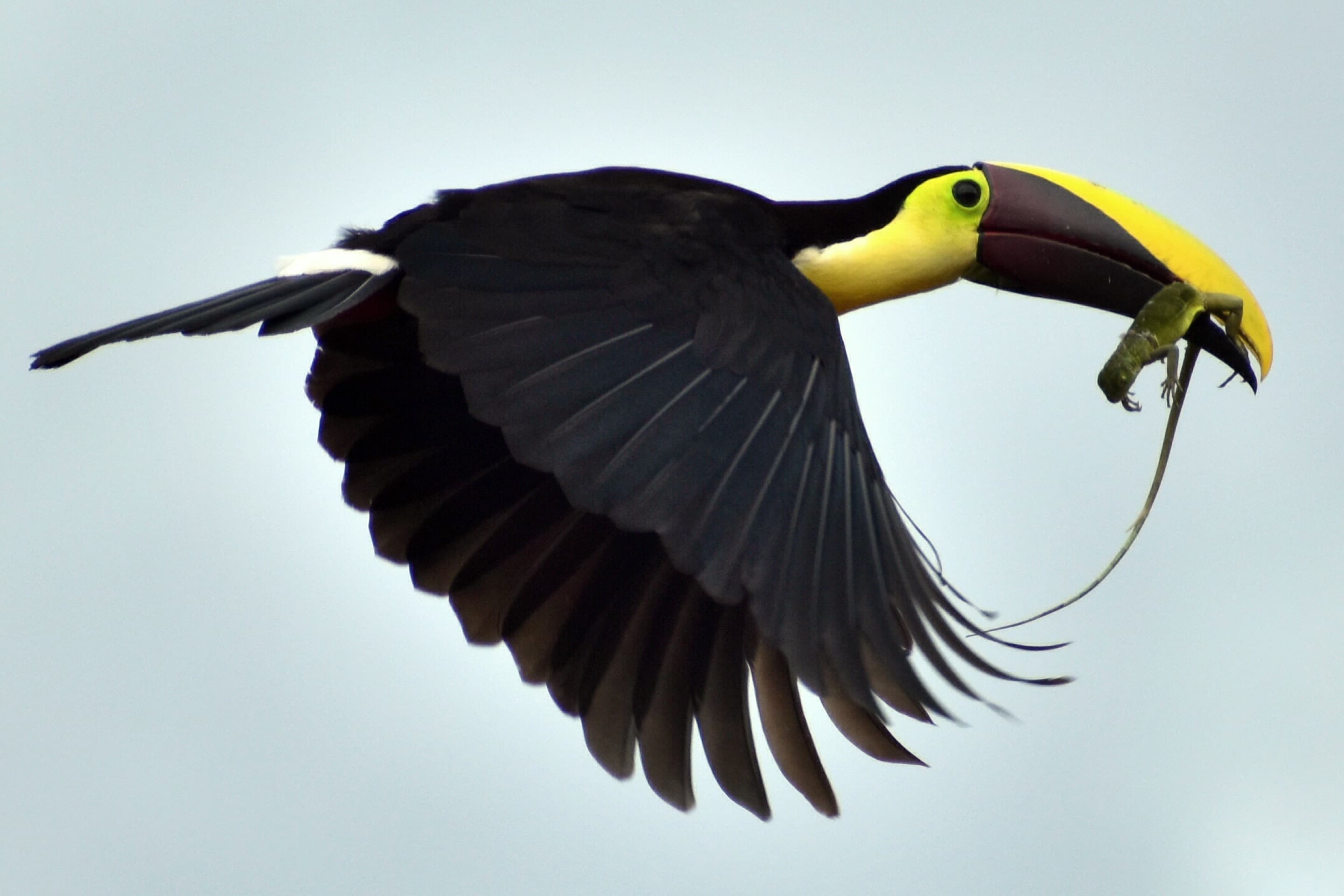
A chestnut-mandibled toucan flying away with a lizard in its beak. Photo courtesy of Karinne Tennenbaum
AM: So the aim is to map who is organizing, where, and how people can connect?
KT: Exactly, I did the inventory on a spreadsheet, but the plan is to make an ArcGIS story map—a public site people can go to. It will show where all the chapters are located, contact information, and a little blurb about each of them, so you can go to that site and get in contact with the people there.
Ideally, there’s also a page with profiles that include little stories about people who got into birding, how they did it, and what they are willing to share. We had a great conversation with the head of the California Young Birders Network, who was really interested in the work.
We applied for grant funding to host a conference, but it might not work out. I think we are going to try to do it virtually this time around. We will do a one-day virtual event, and we might invite Dr. Mya-Rose Craig [a British-Bangladeshi ornithologist, environmentalist, and diversity activist] to do some keynote work. The goal is to get the 17 chapters to send someone and see where it goes.
AM: When do you anticipate launching the platform and convening your first national gathering?
KT: We are aiming for mid-April 2026. It can be difficult because we are reaching out to the biggest Audubon organizations in each state. We had to reach out to fish, game, and wildlife orgs in North Dakota because there weren’t any big Audubon centers. It took a while to hear back. But we have heard from enough now that I feel confident launching the site.
That’s the starting point, and then confirming interest in a date or two in April. I’m going to check in with our entrepreneurial center at Yale and ask if they’ll sponsor an honorarium for a keynote speaker. That’s my first priority. Right now, it’s looking like a one-day virtual event. I’m very against long days on Zoom for kids, so it’s about balancing those priorities.
“For me, bird migration was always a mystery... If I’m going to spend my life working on something, I want to work on the biggest mystery in the field.”

Changes in the environment are affecting bird populations across the globe in a variety of ways. Courtesy of Karinne Tennenbaum
AM: Your work spans community engagement and scientific research. Could you share what you are currently researching and what you hope to pursue next?
KT: Sometimes I work so hard on community engagement, I forget that research is supposed to be my professional job. My senior thesis is on tropical forest recovery. The project I did in Panama was on recovering tropical forests and looking at how predation on these little caterpillars changes as forests regrow. I presented that in October 2025, and I’m writing up the manuscript for publication this semester.
But the plan is to work on birds after this. The project I’m applying for is on partial migration, which is my area of interest right now; populations where some individuals migrate and some don’t. It’s an interesting system when they all breed together. It suggests there might be genetic or environmental differences motivating this behavior. Choosing to migrate thousands of kilometers in winter or not is a big decision that influences survival and reproductive strategies.
I’m really interested in going to Oxford University to study different systems where that happens. Finding migratory genes—the genes responsible for this behavior—is a big thing in the field right now. There has been some success, but not a great deal. I’m interested in whether there’s an environmental component: can we detect it? And if there isn’t any difference, then that’s a really bizarre phenomenon in nature that’s hard to capture.
AM: What field sites and study systems are you most focused on right now?
KT: One project is with Dr. Sonya Clegg in Tasmania. She studies island biogeography and works on silvereyes, these really cute little songbirds with beautiful silver eyes. Silvereyes are a good system to study because they are partial migrants: some spend winter in northern Australia and some stay in Tasmania. If you travel to Tasmania in winter, you can get both without trackers.
Usually, you have to put trackers on birds; they fly away, they come back, you have to retrieve the trackers. It’s complicated. This system helps, and because it’s an island dispersal, there’s less standing genetic variation. It’s not like they have been there forever. Maybe there was a mutation that allowed them to do that.
Then I’ll hopefully work with a group affiliated with the Max Planck Institute and the Institute of Avian Research in northwest Germany, working in Bulgaria on European robins. They are putting trackers on birds and recapturing the same individuals to see if the same bird migrates every year, or whether some years they stay and some years they go.
A third system is in Liverpool with a researcher working on chiffchaffs. They have started wintering in the UK over the last century, so it’s a chance to look at behavior change on a shorter time scale.

Tennenbaum has spent the past year expanding her work beyond campus, building national networks and exploring new forms of public engagement with nature. Photo courtesy of Karinne Tennenbaum
AM: You also raised the possibility that environmental change could be influencing these behaviors. What evidence or observations make that question feel urgent?
KT: Seeing chiffchaffs change behavior over the last 100 years—deciding to winter in the UK rather than migrate—is a pretty different decision for a collective population. That project is interested in survival and selection: are the birds wintering there being selected for? That would suggest birds that stay are doing better.
The environment has been changing. Temperature is changing and food availability is moving, so deciding whether to move is really important. They used to think migrating south meant more food and less energy use. They know that’s not true now. Birds migrating south show the same energetic costs physically as birds that stay, which makes it confusing. Why migrate if you don’t save energy?
AM: As someone who has a very clear field of interest and direction, how did the Young Climate Prize help you connect that research to broader audiences and communities?
KT: One of the biggest lessons I took from the Young Climate Prize was the importance of narrative and continuity. We really focused on making sure our work was visible, whether through a Yale Daily News article, a college newsletter, or consistent graphic design so people could recognize us from one event to the next. That kind of continuity mattered. I also learned how important funding and structure are. I started thinking about our student group almost like a lab, making sure it was always supported and that new ideas could actually be carried out. Those skills translated directly into my research, from planning projects to communicating results. The Prize helped me connect what once felt like disconnected activities into a clear, purposeful path. Even small projects became experiments in what environmental activism can look like, and I realized you never know who your audience will be or how the work will resonate.
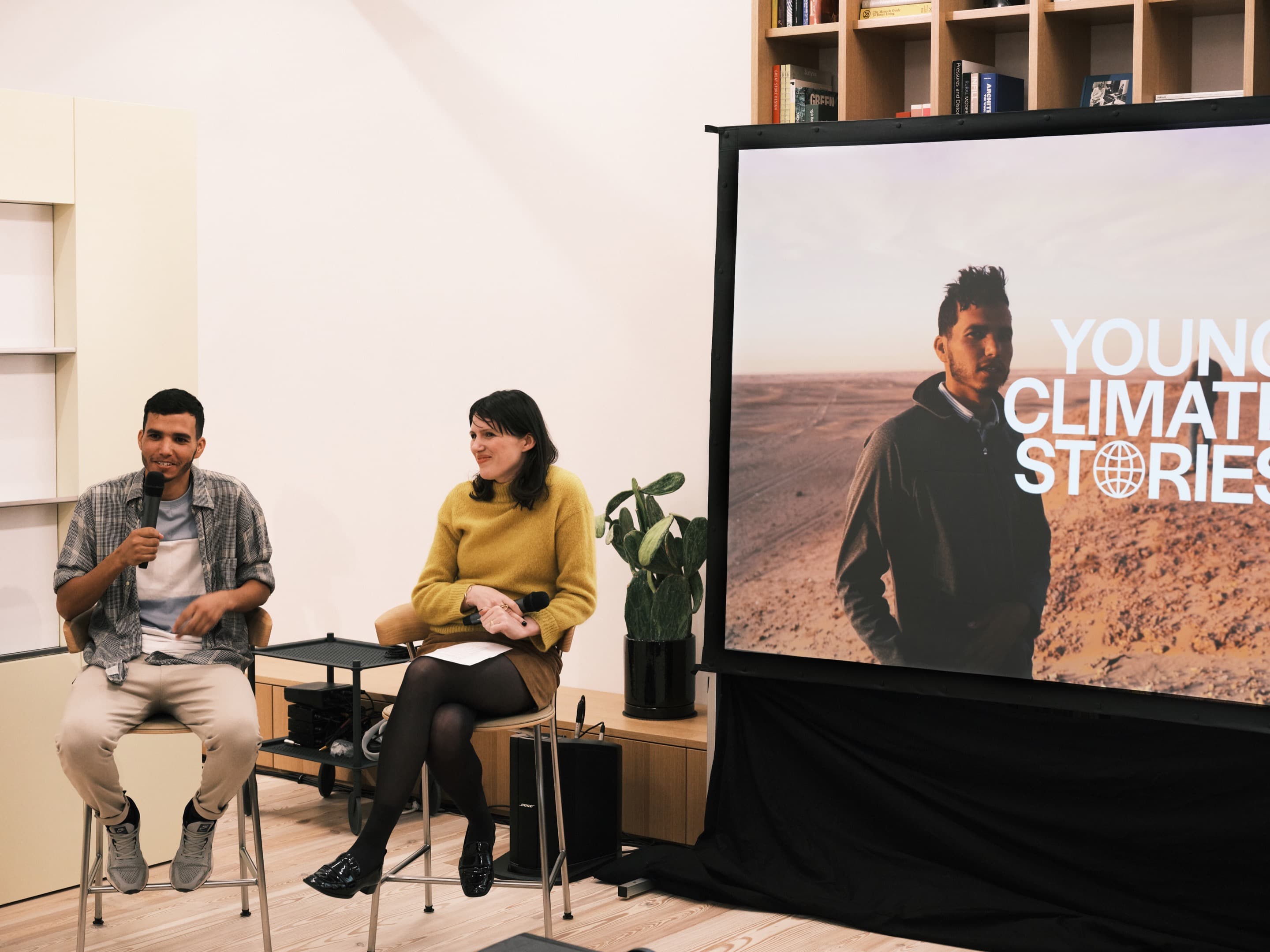
The World Around presents Young Climate Stories
A 4Hawk Production
Made possible by MillerKnoll
Young Climate Stories is a documentary series that follows the young people at the forefront of climate action. Each short film in the series centers a different participant from the second cycle of the Young Climate Prize, exploring how the next generation is working to build a livable, equitable, and sustainable future. Alongside their mentors, these young innovators bring into focus the urgency of the climate crisis and share how they are using their voices, ideas, and designs to reimagine what's possible for communities and the planet.
Related Video