“The Young Climate Prize taught me you can always be an exception”
Working to address top-down change in climate activism via the private sector and policy change in the United States, Young Climate Prize alum Sophia Tabibian is set on bringing people together from around the world to tackle the climate crisis through her various projects: Covalence Global, Stanford Climate Week, and more.
For US-based activist Sophia Tabibian, the climate crisis is deeply tied to economics and how we view resources, materials, and energy. Her goal lies in cultural change via international action, put into play for her Young Climate Prize project, Covalence Global, which she co-founded with colleague Lulu Goulet-Hofsass. Their initiative convened climate activists from five continents, spanning over 20 countries to share perspectives on how to make meaningful, tangible change in the long term. Now, Tabibian is preparing to study material science and engineering at Stanford University, where she will be acquiring skills to eventually found her own climate company. During the first Young Climate Prize cycle, Tabibian was mentored by Bruce Mau, co-founder and CEO of Massive Change Network, and also the creator of 24 Principles of Design for Changing the World, which has heavily influenced Tabibian’s work.
In conversation with The World Around’s Conrad Gowland, Tabibian discusses her life #AfterYCP, having gained a better understanding of how to make meaningful change for climate activism starting with the private sector, and the importance of love, empathy, and patience when finding common solutions that bring people together.

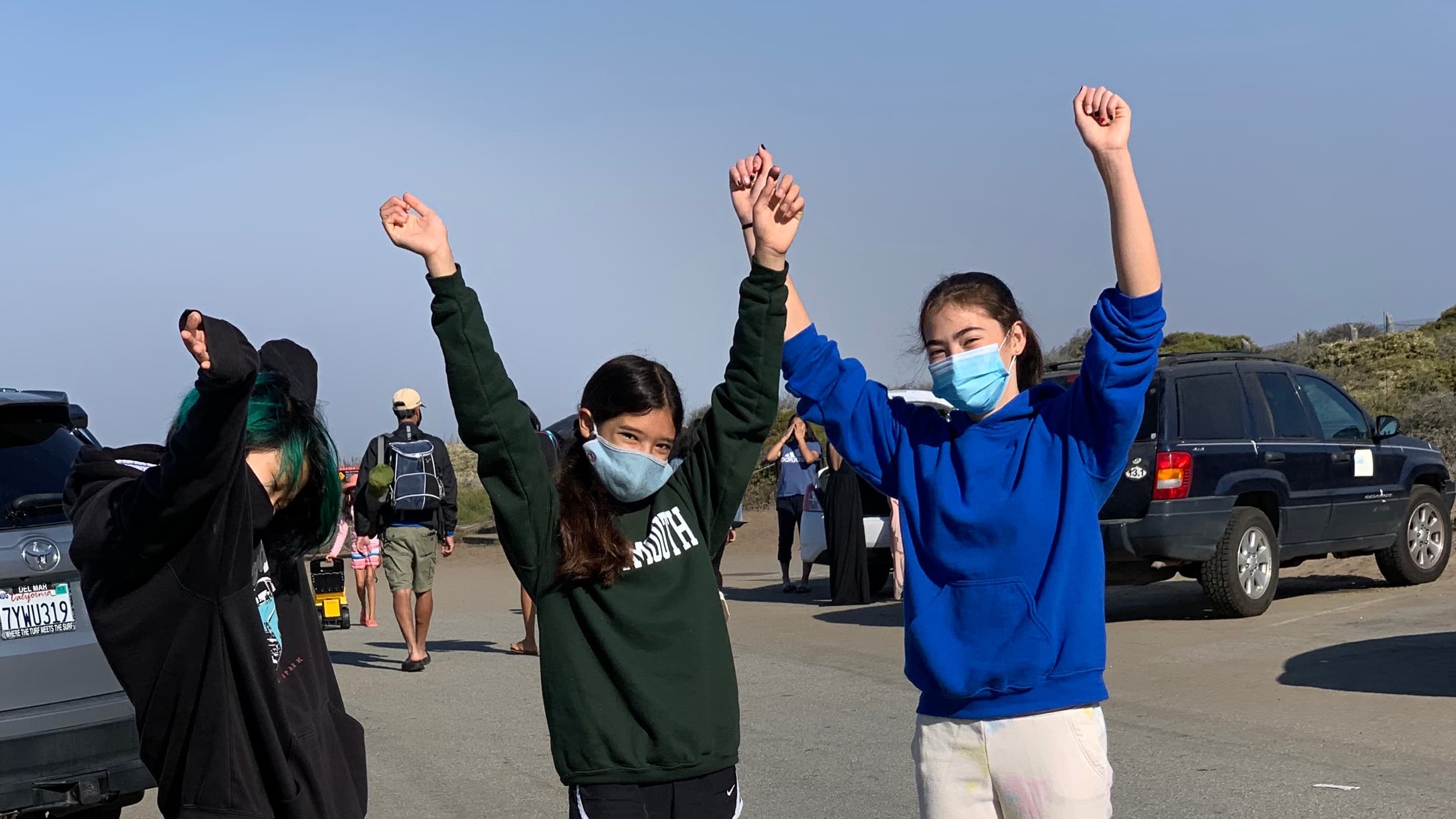
Tabibian started Covalence Global initially doing beach cleanups with her friends in middle school, over the course of which the group collected over 500 lbs of waste products. Photo courtesy of Sophia Tabibian.
Conrad Gowland: Can you tell us a bit about your life since the Young Climate Prize?
Sophia Tabibian: I started the Young Climate Prize when I was 14. Since then, a lot has changed. Now I’m preparing to start my first year at Stanford as a material science and engineering major. This summer I’ve been focusing on energy issues, working with venture capitalists and investment bankers to understand how to orchestrate change from the private sector's angle.
CG: Could you describe your Young Climate Prize project and what inspired it?
ST: I’ve always thought the field of economics exists for a reason: because resources are limited, and we have to figure out a way to allocate them sustainably. That question led me to start a beach cleanup organization in middle school with some other girls. Because high school took place for me during COVID, being socially isolated, I decided to transition from a volunteer-based project to an international network of climate advocates, spanning five continents and over 20 countries. The premise of my project, Covalence Global, was that the only way to orchestrate change is to understand how people from different backgrounds view the climate movement. Every month I would organize seminars on a wide range of topics, be it the renewable energy transition or COP27, in a way that convened young people globally.
CG: Are you still working on that project now? Has it evolved in any way or is that in the past?
ST: That is mostly in the past. Currently I’m helping with Stanford Climate Week this summer. However, much of my focus has been on better understanding the private sector. I believe we can't only have more sustainable technologies. We need sustainable technologies that are cheaper and that are better than their incumbents economically, too. I think that is the issue of the century. It's a question that many are trying to solve, and one that I've really been focused on.
CG: Could you tell us more about Stanford Climate Week?
ST: Stanford Climate Week is dedicated to gathering as many different areas of expertise and bringing them together in a week dedicated to how we're going to move the needle in climate action. As for myself, I'm on the event operations team and I'm also on the impact team. Last year, we had over 60 events and over 1,300 attendees.
“The Young Climate Prize taught me you can always be an exception. It's super important that young people know they can make a difference.”
CG: So much of your work is centered around bringing people together, which is wonderful. Before you signed up for the Young Climate Prize, how did you hear about it?
ST: I was only 14 years old when I looked it up. I wanted to find mentors, because I had so many ideas but didn't know how to bring them about. It was the day before the application was due and I remember scrapping my high school assignments, spending the whole day on my application, then spending the night compensating for my schoolwork. But I'm so glad that I did it. It led me to many other opportunities, like being featured in COP28 in Abu Dhabi, going to Switzerland for the Villars Symposium, and going to Sweden for the Three Dot Dash Global Summit. All of these wouldn’t have been possible if I hadn’t found the Young Climate Prize.
CG: What was it like being so young when you applied?
ST: I almost didn't apply because I said to myself, "There's no way I'm getting this with 24 year olds applying." But the Young Climate Prize taught me to have a “sense of delusion” going into things. I applied without expecting anything and it ended up working out. The Young Climate Prize taught me you can always be an exception. It's super important that young people know they can make a difference.
“The only way to orchestrate change is to understand how people from different backgrounds view the climate movement.”

Covalence Global, the initiative Tabibian co-founded alongside Lulu Goulet-Hofsass, brought people together globally through online seminars and group collaboration. Photo courtesy of Sophia Tabibian.
CG: Could you describe what your experience was like with your mentor Bruce Mau?
ST: Working with Bruce was one of the most transformational experiences I have had. Bruce is known for writing the MC24 design principles. The two that stuck out to me the most were “work on what you love” and “realism-based optimism.”
“Work on what you love” has been very important to me. One of my favorite quotes is, "Except for love, the world's empty." and I use that as a guiding principle for all my work. If I don't love my work, then my work is empty. If I don't love the people I'm surrounded with, then my life is empty.
The other principle is “fact-based optimism”. Having [emotional] energy in the climate space is very important and I spend a lot of time exposing myself to opposing viewpoints, which is draining. Having optimism has been a defining pillar of my life and work. Being able to function in environments where people won’t agree with what you say is very, very hard. Having Bruce's design principles to guide me has been critical.
CG: And aside from the mentorship, what about the Design Academy?
ST: What I loved most about the Design Academy was that it was one of the most international experiences I’d had in a long time. In the US, everything is so US-centric and you don’t realize it. I've never viewed the US as a center of focus since. Another big thing is being able to see how the other Young Climate Prize fellows thought. I think that's what makes the cohort so special. You learn as much from your peers as you do from your mentors.
“You learn as much from your peers as you do from your mentors.”
CG: When pushing investment in sustainability, how can we get people to invest in these things? What’s standing in the way?
ST: I think specifically the issue with the US is that there's a “get rich quick” culture, and when you're expected to generate a certain revenue in the short term, that means that the only person who can really win is a software company. Software companies are great, but hardware companies underlie everything. For example, NVIDIA is actually a hardware company. Materials and energy underlie everything. At least in the private sector, this is not understood in the US. When we have these really high CapEx projects, they take far more than five years, and you have investors needing to see short-term profits.
So we need to eliminate this mentality, and if we want to build generational wealth for our country, we need patience. We also need technologies that make both Republicans and Democrats happy. That's the only way I think we'll be able to move the needle. So the question is, “how can we build technologies that make everyone happy?” Which is something that will be critical to progress.
CG: Finally, what would your advice be to young climate entrepreneurs trying to get into work, into projects?
ST: To be a successful climate entrepreneur, you have to be a talent magnet and you need to have empathy for everyone. It's also important to have conviction, but conviction is built by other people telling you what they need, so I've always valued human connection. Even in the age of AI, I think that human connection is going to become even more important.
Related Video
.jpg&w=3840&q=75)