“When working in a favela, there are many demands that we need to address”
Young Climate Prize alumnus, climate activist and architect Pedro Arlès is involved in a community-led urban effort to solve a slew of waste management issues in Belo Horizonte, Brazil. In conversation with The World Around’s Conrad Gowland, the two explore how his project has evolved #AfterYCP, and the importance of self-sustaining design when working within local communities.
In the narrow streets of the Aglomerado da Serra favela in Belo Horizonte, Brazil, waste mismanagement can lead to far worse than spatial inconvenience and bad odor. Young Climate Prize alum Pedro Arlès and his community-based team sought a solution by founding the project, More Favela, Less Trash (Mais Favela, Menos Lixo) in 2022, to face the neglect of urban waste management following the COVID-19 pandemic. Arlès and his team turned an improvised solution into a widely accessible and comprehensive initiative in which all Aglomerado da Serra residents could participate. Through the aid of ‘garbage hooks’ that keep waste off the ground, residents can now avoid pollution from domestic waste, benefit from better space management, and also access relevant information through a large mural in the favela indicating waste collection sites and services. During Young Climate Prize Cycle 02, Arlès was mentored by Stephen Burks Man Made: the nomadic practice of Malika Leiper and Stephen Burks uniting craft, community and industry.
In this conversation, Arlès talks about his life #AfterYCP, his continued community work, life as an architect, and the projects around waste management and urban design in which he’s currently involved.
%2520Projects%2520Images%25203%2520(1).JPEG%3F2026-08-13T13%3A37%3A48.434Z&w=3840&q=85)
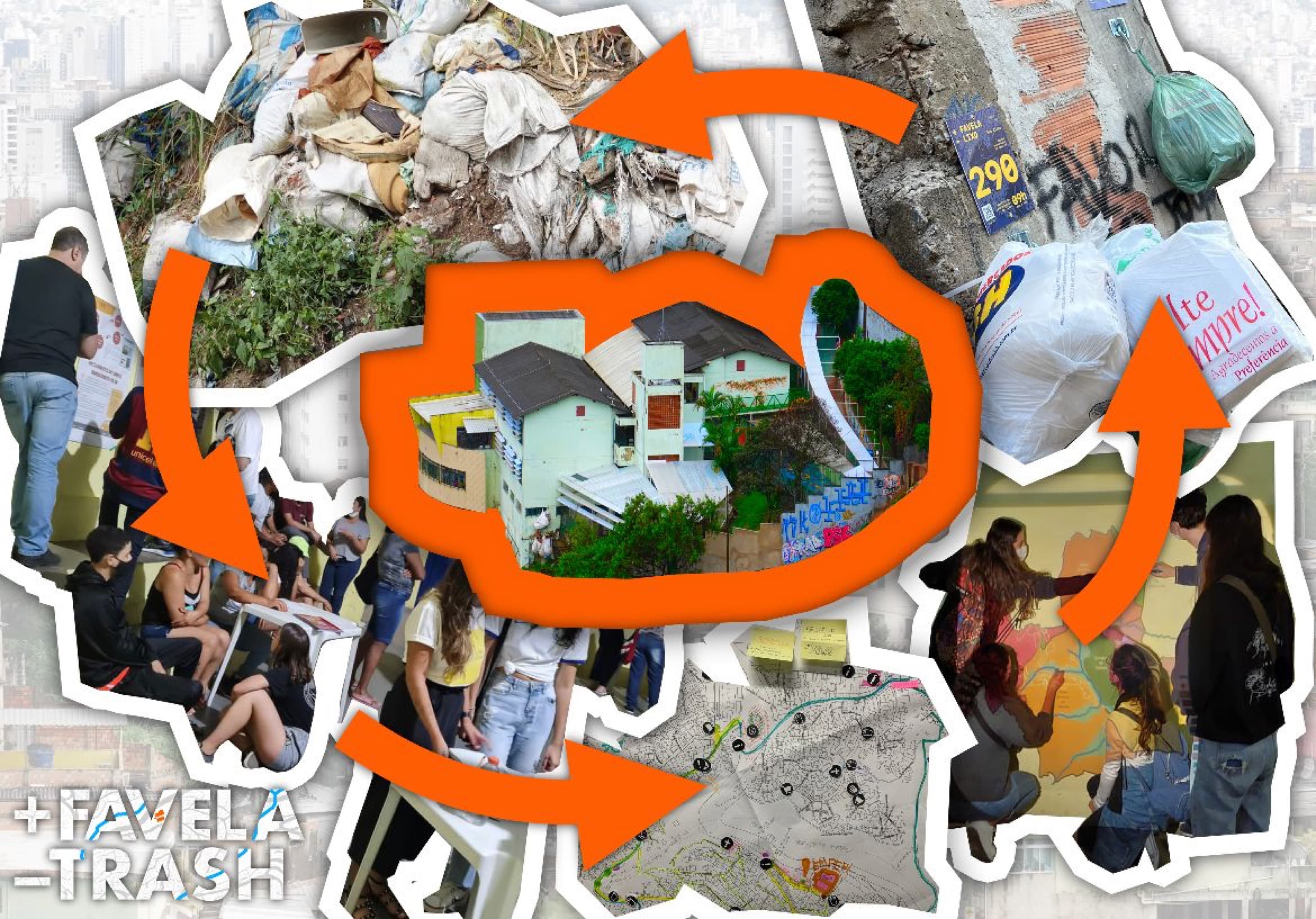
Not only expanding existing local solutions to the waste problem, the project aims to inform where inhabitants can access national infrastructure. The project is informative as it is practical. Photo Courtesy of Pedro Arlès.
Conrad Gowland: Tell us about life recently. What are you currently up to, and who are you working with?
Pedro Arlès: Right now I'm working as an architect in the municipality of the neighboring city of Belo Horizonte, Contagem. I’m working on various problems here in Contagem, but More Favela, Less Trash (with which I applied to the Young Climate Prize) was based in the town called Aglomerado da Serra in the favela in Belo Horizonte. I’m still working on More Favela, Less Trash, and other projects. Over the last year I started working on the rivers in my city, to occupy the areas around them.
CG: Could you explain what a favela is in your own words?
PA: In English, we use the word slum for informal settlements, but it's not an adequate translation. Favelas are a specific type of urbanization found in South America where the people are not the owners of the land. Since there is no governmental infrastructure, they build their own. A huge number of people live in these areas, so a large proportion of Brazil goes without governmental infrastructure and care.
CG: Could you tell us more about your Young Climate Prize project More Favela, Less Trash.
PA: The project began in 2022, at the end of the COVID-19 pandemic. We needed to start addressing the problems that cropped up over the two years before. To be clear, from the beginning, the project was not my project. It was a community project in collaboration with my university and the local school. Thanks to the project, the children involved are starting to read, becoming more present in the environment. It's the perfect age for developing education techniques adapted to the context.
During 2024, the project expanded a lot. I was studying architecture at the University of Minas Gerais and I saw a post on Instagram from an architect I like saying, "The Young Climate Prize is a great opportunity for you to promote what you are doing and access mentorship.”
When working in a favela, there are many demands that we need to address for any project: working with a public school, we had the opportunity to collaborate with the adults taking literacy classes. During these classes, we held discussions about the most urgent community demands.
Over the course of the pandemic, the wall of the school became a very large waste deposit. There was garbage everywhere and abandoned cars in front of the school. Since no kids were there, no one was reclaiming that space and it was total chaos. Every adult who was also studying there said it was time to address the issue.
This is very much a part of the architect's job. You have to be able to conduct self-management in a space, but also to build with participatory process, by listening directly to the community. We started by analyzing the context, understanding in what ways we could manage the trash, and to find what the architect’s role is in that.
“When you go to take out the trash, you just put it in the garbage bin and it disappears almost like magic. The next day it's gone. In the favelas, it's a very different scenario.”

Aglomerado da Serra is home to around 50,000 people, most of whom do not have access to much governmental support. Photo by Eduardo Ramos.
CG: Could you tell us about your experience during the mentorship program, and about your mentors?
PA: The mentorship was amazing. That was the most important part of the prize for me. Stephen [Burks] and Malika [Leiper] were amazing tutors. They taught me how to understand more about my design. I learned that I was adapting an existing design that a lot of people have been working on for generations.
Stephen and Malika are amazing designers who design not just with materials, but processes, alongside manufacturing traditionally and respectfully. They taught me how we can manage the entire cycle of a design project.
In the end, the biggest result of the program for me was that I made it to the São Paulo Architecture Biennale. Stefan and Michela were presenting their project, An Architecture of Generosity at the 2025 Venice Biennale. Then, after I mentioned that it was my dream to be there, they said in response, "Why don't you start with the São Paulo Biennale?" I ended up making it there, which was fantastic. This was a direct consequence of the mentorship project.
CG: Coming back to the project, could you tell us more about the specific consequences of unmanaged waste in the region?
PA: This is a very important question because people who don't live in the favelas experience trash and waste management in different ways. When you go to take out the trash, you just put it in the garbage bin and it disappears almost like magic. The next day it's gone. In the favelas, it's a very different scenario. They take it out, but the alleys are so narrow they become difficult to walk in. Children struggle to go to school because they have to walk in the road, because the sidewalk is covered in trash. Equally, when the elderly trip it can cause a lot of harm. Otherwise, when so much waste accumulates in a single spot, contaminated rainwater flows into the rivers, not just polluting the ocean, but also the area around it. Everyone is affected, not only by disease; not only by the fact that it smells bad, but also because of the way the city works.
“Architecture needs to be done through self-management processes; projects need to be self-sustaining, and you can only accomplish this through collaboration. ”

Arlès has recently worked on inhabiting the river areas around Belo Horizonte with public spaces.
CG: How important is it to teach people about waste management?
PA: So we don't really teach people about the trash. They already know about this problem, they live it every day. Often they don't know where they can demand solutions. Normally this lies in who to ask in the government, so the problem becomes, “how can we demand this?” For context, in favelas there are no maps. There is no way to access information of this kind. So really, we don’t teach, we just make existing information publicly available.
CG: Community is one of the big aspects of your project and the way you work. What would you say is the benefit of working as a community?
PA: Precisely, Architecture needs to be practised through self-management processes; projects need to be self-sustaining, and you can only accomplish this through collaboration. When I published the project description, I tried to make it clear that we are not able to do something in a territory we don't know. Through local knowledge we were able to come to an efficient solution. If a person lives there every day of his life, they already know this. In this case, our main intervention was the hooks for the trash suspension. But before we formalized the project, this system existed informally.
CG: Finally, do you have any future plans or advice to others?
PA: We’re always trying to evolve in different areas for the project, so it's very difficult to predict what we are going to do next because the problem and maybe its solution could appear out of nowhere, or even disappear too. We are continuing to work within the demands of the community. This year we have been finishing the project we started in 2022, after three years of development of composting systems that function in the favelas.
If I could give my advice to other architects and other designers, it would be to work through self-management. There is no other way. You’ll get good results from these community-led projects.
The World Around presents Young Climate Stories
A 4Hawk Production
Made possible by MillerKnoll
Young Climate Stories is an ongoing multimedia series that follows the young people at the forefront of climate action. Each story centers a different participant from the Young Climate Prize, exploring how the next generation is working to build a livable, equitable, and sustainable future. Alongside their mentors, these young innovators bring into focus the urgency of the climate crisis and share how they are using their voices, ideas, and designs to reimagine what's possible for communities and the planet.
Related Video
.jpg&w=3840&q=75)