
“I never imagined that menstrual pads could connect to climate impact”
Young Climate Prize alum Esther Olalude’s company Venille Limited, produces and distributes sanitary pads made from banana stem fibers across Nigeria. In this interview as part of our Young Climate Stories series, she discusses her aims to facilitate access to menstrual health products, fight period poverty, and teach young women about sustainability and period health.
The lack of access to menstrual health products for women and girls across the globe not only poses an immediate health risk, but also creates long-term disadvantages. And even where access to sanitary products is available, many are made from up to 90% plastic.
Climate activist Esther Olalude is addressing these issues through her enterprise Venille Limited. Based in Jos, Nigeria, Olalude and her team are producing and facilitating access to menstrual health products for girls and women across the nation. Venille’s products are derived from biodegradable banana stem fibers, a locally sourced and viable solution that serves as a more sustainable alternative to the high-plastic industry standards. Olalude’s work also involves teaching girls in schools about period health, the climate crisis, and the connection between the two issues. During the Young Climate Prize Cycle 02, Olalude worked with her mentor, human-centered design architect Etta Madete, to develop her project and eventually launch the Venille AI app. This enables menstrual cycle tracking, and access to a chatbot that provides free and confidential advice. She is currently developing an offline feature for people living in remote areas.
In conversation with The World Around’s Conrad Gowland, Olalude shares what inspired her to start the project, the importance of menstrual health advocacy, and sanitary pad industry’s shift towards sustainable alternative materials.

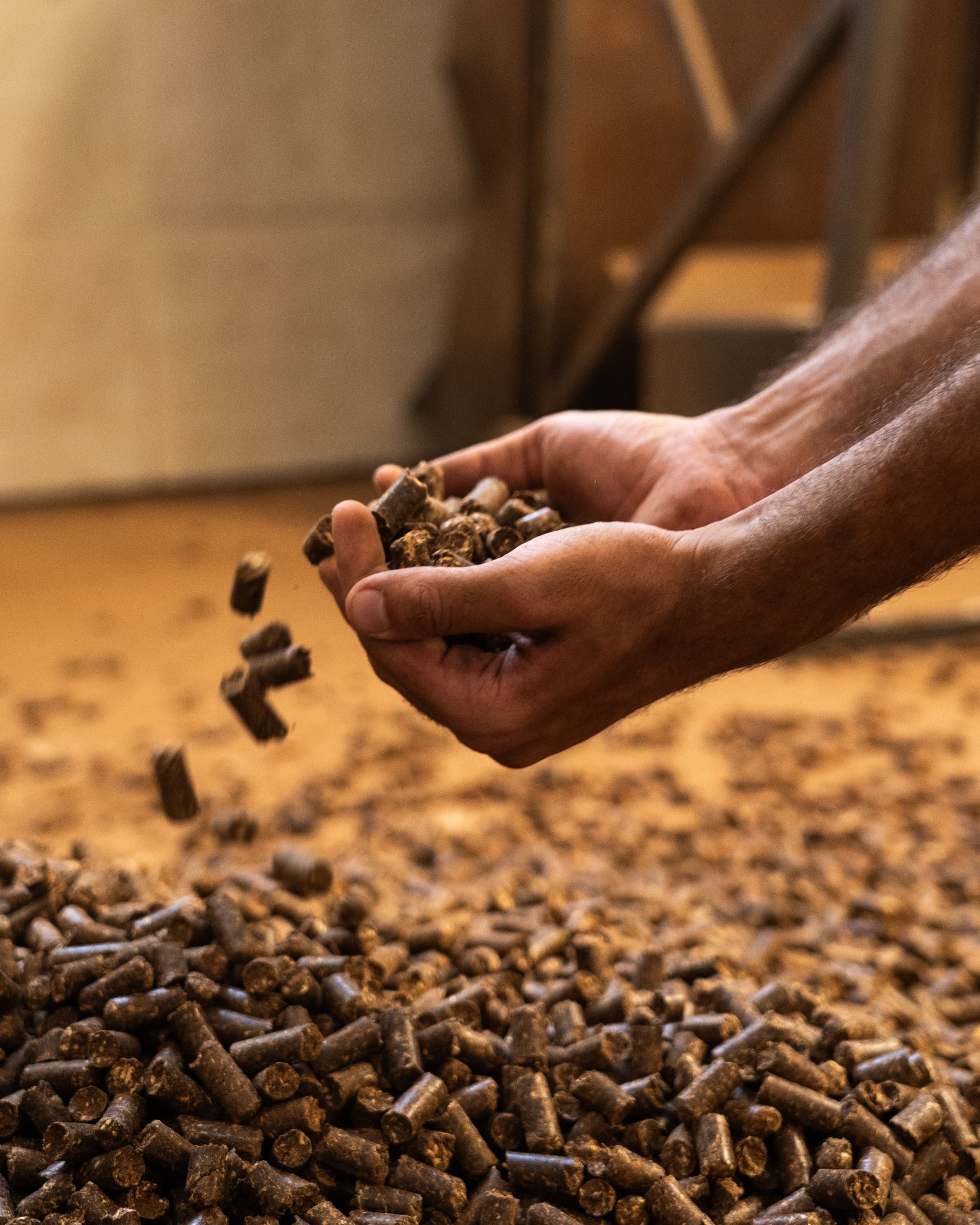
Olalude developed an affordable, biodegradable alternative to conventional sanitary pads, using an absorbent core made from a wool-like fiber derived from processed banana stems. Photo courtesy of Esther Olalude.
Conrad Gowland: Could you tell us what you are working on?
Esther Olalude: I am currently working on Venille Limited. We produce biodegradable sanitary pads made out of locally sourced banana stem fiber to combat two major issues: period poverty, and the inaccessibility of sanitary products for girls during their periods. If they can't go to school or they can't go to work during their periods, this leads to further marginalization of girls and women generally. We are also fighting the growing problem of plastic pollution which deeply affects the climate as well. Regular sanitary pads are made out of up to 90% of plastic at times and when these parts are disposed of they take centuries to decompose. They end up in landfills, releasing microplastics into the ocean.
We have also developed a phone app called Venille AI, a menstrual health assistant which tracks the period, gives reminders and has an AI chatbot where girls and women can ask questions they may not be very comfortable asking other people. We're looking towards implementing a USSD (unstructured supplementary service data) feature so that even girls who are in low connectivity areas can access it.
CG: I'd love to ask you a little bit about how you got into the project. What inspired you to start Venille, and climate activism generally?
EO: Before I got into volunteering and advocacy, I was already interested in sustainability, which I learned about further by studying environmental geology. Initially, one of the NGOs I volunteered with was the Pad a Girl initiative, which gave out reusable sanitary pads to girls in a village on the outskirts of my local town.
I remember talking to a girl saying that her twin sister was not in school because she was on her period that day. I told her, "We've given out reusable sanitary pads so that shouldn’t be a problem for you." But she mentioned how in their village they also have a problem with water and reusable sanitary pads are actually high maintenance. That moment made me understand that when providing solutions to most of these issues, you need to be holistic. You need to understand the needs of the people you're trying to help.
When developing our product, I had seen the use of bamboo fiber for sanitary pads, napkins and other products. Our research group settled on using banana stem fiber instead because it is abundant where we are and we formed our own production processes. From this point onwards we were able to develop Venille into what it was for the Young Climate Prize through some grant funding.
CG: As you described it, it sounds like localized problems with localized solutions. Could you describe how you came across the Young Climate Prize, and what compelled you to apply?
EO: The prize was offering a community of people with a goal similar to mine. I understood that they were looking for applicants with a product, but who were also doing several other things to solve the climate crisis in their own ways. The idea of having access to that community was very interesting to me. We were barely one year into Venille, and I wanted to know what direction to go in to make sure that I could expand and deepen my impact.
“As a result of menstrual health issues, girls and women are not able to fully participate in the economy, in academics, or take advantage of opportunities that are presented to them. There's a massive knock-on effect from that.”

Olalude’s work also involves teaching girls in schools about period health, the climate crisis, and the connection between the two issues. Photo courtesy of Esther Olalude.
CG: What was your experience with the mentorship program?
EO: Etta Madete was my mentor for the prize, and she understood that I wanted my project to be impactful but also that it was a business that needed to be viable. She actually introduced me to several concepts that I had only heard marginally before. I was able to apply them into my business and help it grow.
The Young Climate Prize also helped in validation. It helped that I was doing something that was recognized, as one of 25 people selected from so many applications all over the world. It was very encouraging. It was a pivotal moment for us as a business and as a climate impact organization.
CG: There are two obvious aspects of Venille: there's the work with sustainable materials, but you’re also facilitating access to menstrual health. Could you describe some of the outreach work you do?
EO: When we do educational outreach, we also distribute these pads and we explain what they can do to fight against climate change. We encourage girls to engage in healthy practices, in how they manage their water, or their waste disposal. We educate them about the problem and on how they can play their own part in reducing it.
Part of the outreach is to invest in sociocultural change as well. As it is, as a result of menstrual health issues, girls and women are not able to fully participate in the economy, in academics, or take advantage of opportunities that are presented to them. There's a massive knock-on effect from that.
“The Young Climate Prize taught me that as long as you're an individual who wants to make an impact, there is no end to the ways you can do that.”

Olalude's work bridges climate action, health equity, and gender inclusion by providing access, employment, and education to underserved communities. Photo courtesy of Esther Olalude.
CG: From a more practical perspective, what does the distribution of the product look like for you?
EO: We’re actively trying to reach women in last mile areas. Through our app, girls and women can order our product. We also do partnerships with schools and NGOs. Some schools actually order pads monthly. We also distribute to NGOs who want to do their own outreach at discounted prices. Right now we are working on getting our exportation documents so that we can export out of Nigeria, internationally.
CG: Are you addressing an existing issue in Nigeria with menstrual education? What's the framework in schools for teaching children about menstrual health?
EO: In the classroom, I would say it’s fairly inadequate. Usually you learn about menstruation in biology class, and usually the teacher glosses over it in a way. But I was well into my young adulthood when I found out that each month involves four phases. Many girls, especially those in rural areas, engage in very dangerous practices. They sometimes use herbs instead of sanitary pads for example. These practices can cause infections and worst of all infertility or even death. These things happen because there's a cultural problem. We're also trying to combat that, because this lack of knowledge even in their teenage years ends up affecting these girls later on.
CG: Could you tell us a bit about the future of Venille?
EO: Right now we're looking to expand our manufacturing. I like to say that one thing the Young Climate Prize taught me is that as long as you're an individual who wants to make an impact, there is no end to the ways you can do that. We had other fellows in the cohort who were doing things that I never imagined could connect to climate impact. As a child I actually never even imagined that pads could connect to climate impact. Our plan is to distribute both within and outside Nigeria and Africa, expand the AI app and its capabilities, and enable interaction in multiple languages. That's our short-term plan. But for the long term, who knows? All I know is that we're going to be making a great impact.
Related Video

Venille Pads
Young Climate Prize