Meet Tomorrow, Young Climate Prize Cohort 03
Introducing the amazing and talented cohort of The World Around Young Climate Prize, Cycle 03!

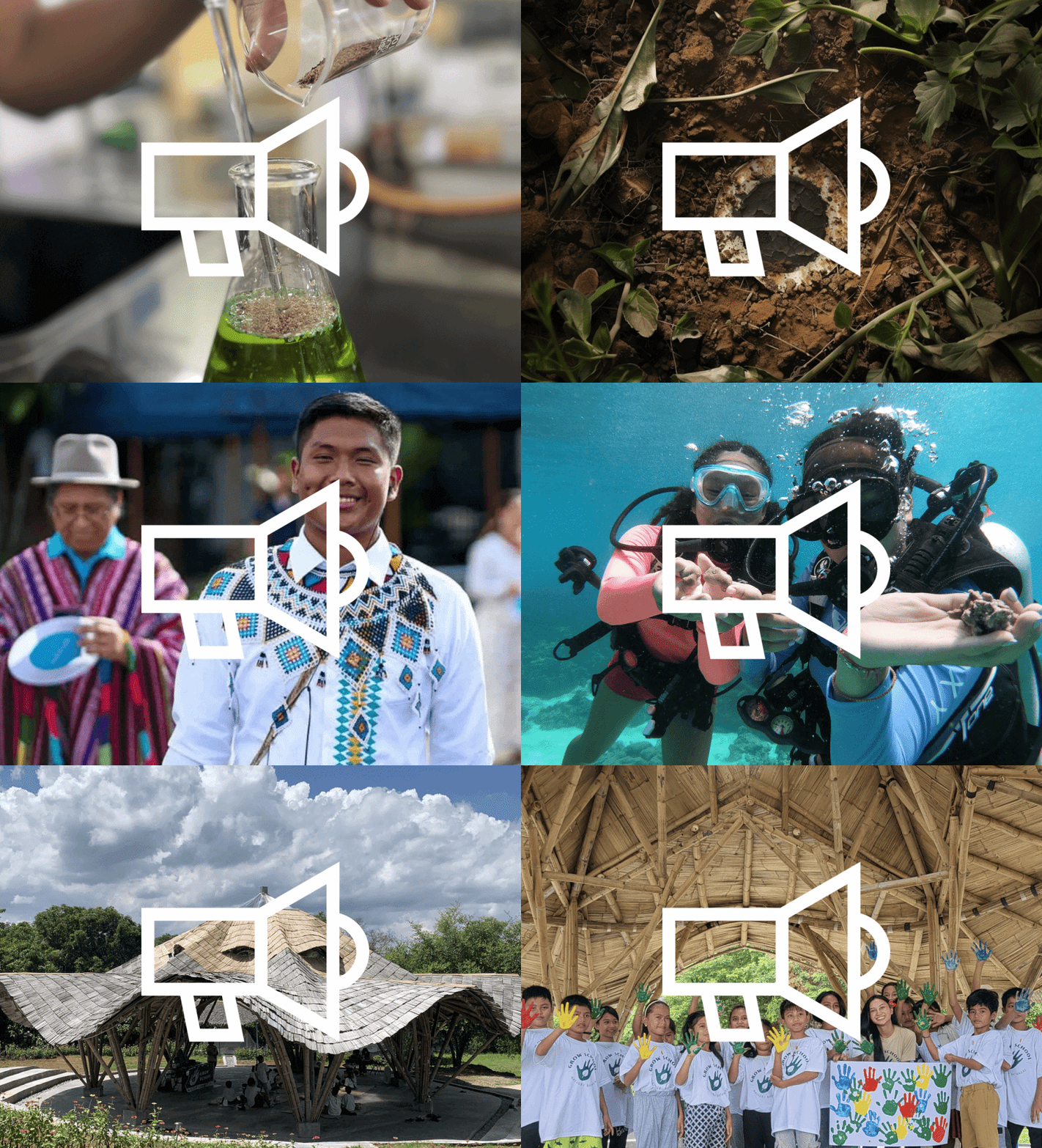
Gauri Gautam’s Mycelius: Mycelium-based materials made from agricultural and textile waste, developed for interior products.
The World Around is excited and proud to introduce the amazing and talented 23 finalists for the third cycle of its Young Climate Prize. The brilliant Cycle 03 cohort of young innovators range in age from 15 to 25 and is drawn from 16 countries. working at the intersection of material science, ecological repair, infrastructure and cultural organizing. Selected from 490 applications across 85 countries, the 2026 cohort represents the largest and most geographically diverse pool in the prize's history.
Now in its third cycle, the Young Climate Prize has become one of the most significant platforms for identifying and supporting youth-led climate action across the design and architecture world. Launched by The World Around in 2022, the program pairs finalists with individual mentors from architecture, design and related fields over three months, before a jury review and the announcement of winners in early 2027.
The bright minds from the next generation of climate leaders selected for this cohort are the designers, visionaries, and voices that will make the world around safer, greener, and brighter. Each has a self-initiated project that tackles an issue facing their community or environment—from biodegradable materials to coral reef restoration; climate-adaptive prosthetics to paper batteries; fire-resistant gel to micro-plastic removal. All are developing innovative solutions to tackle the climate crisis, and providing hope and new possibilities for the future.

Ariana Agarwal’s Plas-Stick: A biodegradable material made from discarded tamarind seeds and magnetic nanoparticles that binds and removes microplastics from drinking water without electricity. Photo Courtesy of Ariana Agarwal.
The cohort of Cycle 03 spans four areas of work: Protecting Public Health, Ingenious Material Transformations, Ecological Restoration, and Leading Culture.
In Protecting Public Health, Ariana Agarwal and Vivaan Chhawchharia, 16, from India, developed Plas-Stick, a biodegradable material made from discarded tamarind seeds that removes microplastics from drinking water without electricity. Ahmed Sajidan Jarjis Rafsan, 23, from Bangladesh, founded three organizations spanning flood response, health systems and repairable prosthetics. Carla and Rareș Gheorghe, 16, from Romania, built Lichenary, a citizen science platform using lichens as air quality bioindicators, now expanding into moss-based filtration panels. Ryan Murphy, 16, from Thailand, built low-cost HEPA air purifiers from locally sourced components for classrooms in Bangkok's Khlong Toei district. Rushil Hari Koppaka, 24, from India, is adapting wastewater treatment infrastructure in Mumbai to remove and store atmospheric carbon dioxide. Sofía Méndez Roca, 19, from Bolivia, developed PyroGel, a plant-derived hydrogel designed to slow wildfire ignition without leaving toxic residue in soil.

In Ingenious Transformations, Carlo Charles, 25, from Singapore, developed Flint, a rechargeable cellulose-based battery made from agricultural waste — with no lithium, cobalt, or nickel. Ella Csuka, 25, from the United States, is developing bio-based textiles as alternatives to petroleum-derived fabrics through Ecotune. Gauri Gautam, 25, from India, is creating mycelium-based materials from agricultural and textile waste for interior products through Mycelius. Janet Dete and Damaris Kuria, 25, from Kenya, are converting discarded synthetic hair into fiber for handbags and home goods through Queening Afrika.

Pynbhairoh Snidvongs Kruesopon and Charlotte Khoo’s Care for Coral: Youth-led coral restoration and coastal-resilience education founded during the pandemic.
In Rewild, Restore and Radically Repair, Bolesław Jacaszek, 18, from Poland, is converting university lawns in Gdańsk into semi-natural meadows for wild pollinators through Miejska Miedza. Cléusia Cardina, 24, from Mozambique, is restoring a riverbank in Chizombero using buffer planting, a community tree nursery and low-cost irrigation built from recycled bottles. Pynbhairoh Snidvongs Kruesopon and Charlotte Khoo, 19, from Thailand, founded Care for Coral, a youth-led coral restoration and coastal resilience education initiative. William Tan, 15, from the United States, is building sensor-equipped artificial reef structures paired with student-led marine engineering programs through Build A Reef.

Robyn Camille Mijares’s Grow School Philippines: Founded the country's first bamboo farm school, reaching more than 98,000 students with free environmental education. Photo Courtesy of Robyn Camille Mijares.
In Leading Culture, Denise Ayebare, 23, from Uganda, works with refugee and displaced women on climate-adapted farming through BetterLife International, including a soil monitoring app. Ema Poposka, 18, founded Making Waves Club, an international youth ocean conservation film festival, at age 12. Cristian Jossias Beker Quintero, 18, from Panama, brings young people, including Indigenous youth, into local climate policy processes through Bocas del Toro Youth for Climate Action. Robyn Camille Mijares, 25, from the Philippines, founded the country's first bamboo farm school, now reaching over 98,000 students with free environmental education through Grow School Philippines. Veldesen Yaputra, 24, from Indonesia, works with artisan communities in China, Indonesia and Peru to bring traditional craft into contemporary products and exhibitions through Amurta. AJ Raymundo, 23, from the Philippines, documents fishing communities on Laguna de Bay displaced by a government expressway through film and salvaged material art. Sumaya Saidi, 21, from Afghanistan, built Hamra Green, a digital environmental organizing platform translated into Dari and Pashto.
This year's mentors include designer Bruce Mau, MoMA curator Paola Antonelli, landscape architect and MacArthur Fellow Walter Hood and architects Tatiana Bilbao, Anna Heringer and Xu Tiantian, among others.
"The global youth climate movement is a wellspring of inspiration, outlining in the starkest possible terms the stakes and the ingenuity of the generation that will live with this crisis the longest," said Beatrice Galilee, Founder and Executive Director of The World Around. "Many of our future climate leaders are just getting started."