“Without vernacular thinking, architecture risks losing its moral responsibility”
Through collaboration with regional artisans, Himalayan architect Rahul Bhushan’s studio NORTH transforms traditional local building knowledge into resilient contemporary architecture.
By Sunena Maju
.JPG%3F2026-02-25T03%3A15%3A43.506Z&w=3840&q=85)
Aeja Project by NORTH. Photo courtesy of NORTH
Founded by architect Rahul Bhushan in the Kullu Valley of Himachal Pradesh in India, NORTH is a design and research practice working at the intersection of architecture, ecology, and craft. Drawing on vernacular Himalayan traditions such as kath-kuni timber construction and stone masonry, the studio develops contemporary building systems rooted in local material intelligence. Projects ranging from community-built homestays and craft-led hospitality spaces to experimental residential prototypes are realized through close collaboration with regional artisans and farmers. In this interview, Bhushan talks about North’s on-site material experimentation, research-driven design, and how the work reimagines traditional knowledge as a living framework for climate-responsive architecture in fragile mountain ecologies.

Details of Aeja Project by NORTH. Photo courtesy of NORTH
Sunena Maju: What led you to establish NORTH in Himachal Pradesh, and why did it feel important to build a practice here?
Rahul Bhushan: For me, the idea didn’t begin with a desire to start an architecture studio or to create a campus. It began from a much deeper place, from looking at how the Himalayas are being treated today, and at the larger global direction we seem to be heading towards.
Because Himachal is my home, I understand this landscape most intimately. It felt like a personal responsibility to contribute something meaningful to the place that has given me everything. So NORTH was born not as a business idea, but as a moral and existential decision.
Architecture became the medium simply because that is the language I know. The intention was to create a space where we could practice architecture, conduct research, and develop solutions rooted in applied sustainability and deep material exploration, where traditional intelligence and time-tested skills form the foundation of everything we do. Not in a nostalgic sense, but as living systems that can be tested, adapted, and made relevant again.
More than cities, it is our villages that hold culture, knowledge systems, and community values. That is where change has to begin at the grassroots level. For me, Himachal and I are part of the same story, and building NORTH here was less about choosing a location than about acknowledging where I come from.
SM: How did your own upbringing and experiences in the mountains shape the way you think about architecture today?
RB: Almost everything about how I think creatively comes from living in the mountains. Mountain communities teach you to think collectively, for your family, your village, the people around you. Relationships often come before transactions, and that reflects strongly in how I collaborate and build teams today.
Life here is slow, and that slowness builds character. You spend time in observation, watching seasons change, farming cycles unfold, materials age. That space of nothingness is incredibly important for creative work. You are not constantly rushing or comparing yourself to others; instead, you learn to remain contained within your own process.
Living in the mountains also teaches you to truly know your context. These are not theoretical lessons but everyday experiences, collecting wood, harvesting crops, observing how people live with limited resources. Over time, these values become the root of your creative output.
The mountains also strip away your ego. When you encounter buildings that have stood for centuries, you realize that architecture outlives us. It carries emotional memory and belongs more to the land and its people than to the person who designed it. That awareness changes your purpose, you stop thinking about personal success and begin asking what will outlast you.
“More than cities, it is our villages that hold culture, knowledge systems, and community values.”

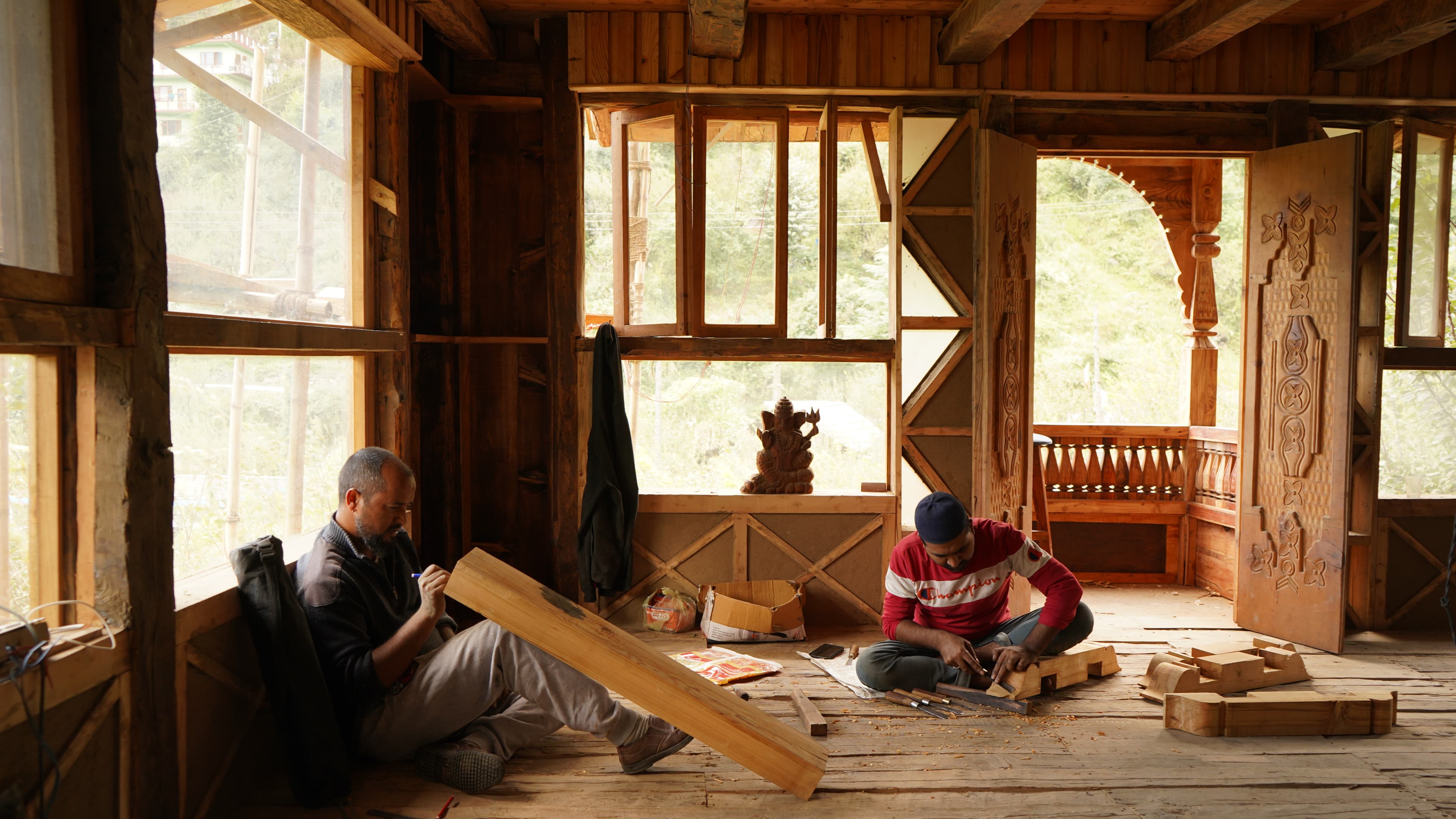
Wood carving by craftsmen at NORTH. Photo courtesy of NORTH
SM: NORTH is often described as more than a studio; it's a mix of research lab, residency, and community space. Was that always the intention, or did the practice evolve organically into this form?
RB: NORTH was never intended to be an architecture practice in the conventional sense, because that would mean starting with a business model and then trying to add meaning on top of it.
The original intention was to revive and apply traditional building systems, and knowledge of constructing resilient homes, using natural, locally available materials. But it was never only about preservation or documentation. It was about application, using this knowledge in real projects, understanding why certain systems stopped being used, and exploring how they could be adapted for today.
As I began working closely with craftspeople, farmers, and local communities, it became clear that this work could not remain limited to drawing buildings. It had to include research, teaching, and shared living. Over time, NORTH evolved into what we think of as an alternative school—a place where learning happens through hands-on work and everyday practice.
Tourism became another important layer. Instead of rejecting it, we tried to redirect it by creating stays built using local knowledge but innovated for contemporary needs. These spaces act as living demonstrations of ideas that visitors experience directly and begin to see that traditional systems can also be modern, comfortable, and resilient.
SM: Your work is deeply rooted in vernacular Himalayan building traditions. How do you define “vernacular” in your practice?
RB: For me, vernacular is not a style or an aesthetic from the past. It is a value system, a form of contextual and material intelligence that comes from grassroots knowledge.
Without vernacular thinking, architecture risks losing its moral responsibility. When buildings are designed with short-term priorities—cost, speed, fashion—they are made to last only a few decades. In contrast, vernacular architecture was built to endure, to age with dignity, and to belong to the land.
We treat vernacular as time-tested knowledge that can guide innovation rather than constrain it. It gives us fundamental principles, such as understanding climate, material behaviour, social patterns, which then become frameworks for creativity.
Even when our work appears contemporary, the thinking behind it remains vernacular. For me, vernacular is not in the form. It is in the process, in how deeply you understand materials, contexts, people, and time, and how honestly you take responsibility for what you create.
“Vernacular is not a style or an aesthetic from the past. It is a value system, a form of contextual and material intelligence that comes from grassroots knowledge.”

Rahul Bhushan, founder and principal architect of NORTH. Photo courtesy of NORTH
SM: Can you talk about the role of material experimentation in the studio? How much of your design process happens on site, with craftsmen, rather than on the drawing board?
RB: Our process always unfolds in two parallel ways. One is conceptual, thinking about space and narrative, and the other is material, where you engage physically with the site.
I spend a lot of time on site with craftspeople because material defines almost everything. If I am working with wood, I need to understand its structural potential and limits. If I am working with stone or mud, I need to understand how it behaves and how it can be reused.
Many decisions are made on site, responding to what the material allows. We also look at how traditional material intelligence can be translated into contemporary systems. For example, exploring how fibers like hemp or nettle might be used structurally, or how reclaimed elements can carry forward their character instead of being discarded.
Architecture is not about imposing form on material but allowing material intelligence to shape the form.
SM: Collaboration with local artisans is a recurring theme in your projects. How do these relationships shape the final architecture? What have you learned from working with craftspeople that architectural education didn’t teach you?
RB: My real learning began after returning to the Himalayas. Working with craftspeople reshaped my thinking entirely.
In older times, the architect and the craftsperson were often the same person. Over the years, because of standardization and industrial systems, that connection has been broken. Craftspeople lost their design agency and were reduced to executing what the market or the client demanded, even though they still hold deep knowledge of materials and construction.
Our team includes architects, engineers, product designers, farmers, and craftspeople. We approach projects collectively, inspired by how traditional communities functioned, where different forms of knowledge came together naturally. That shift brings dignity back to craft and depth to design.
“Architecture is not about imposing form on material but allowing material intelligence to shape the form.”

NORTH estate at Himachal Pradesh in India. Photo courtesy of NORTH
SM: Mountain regions are increasingly vulnerable to climate change and ecological pressure. How do you see the role of architecture in responding to these challenges?
RB: I completely agree that mountain regions are extremely vulnerable to climate change and ecological pressure, and I also believe that architecture plays one of the most important roles in this crisis because buildings are among the largest contributors to carbon emissions.
I have personally seen how the Himalayas are changing, and I do not want the ignorance of the current generation to destroy the future of the generations that will come. Nature will always take back what we build. We are very small in front of it. One natural disaster can wash away entire concrete cities in a moment, and then we are forced to start again from nothing. The real danger is not collapse. Collapse will happen anyway. The real danger is losing the wisdom of how to begin again.
If we lose traditional knowledge systems, if we forget how to build with the land, with materials, and with climate, then even after collapse we will not know how to rebuild. And that is why I feel we are at the eleventh hour. We are very close to saturation, but we still have time. This is not a moment to make things sound nice or hopeful without honesty. This is an alert zone. We need to educate, build awareness, change policies, and think long-term. Not in terms of what we will earn in the next ten years, but in terms of how humanity will survive and how it will continue to live meaningfully on this planet.
SM: Looking ahead, how do you imagine NORTH evolving over the next decade, both as a studio and as a cultural platform?
RB: The next decade is such a long time that I don’t really see it as a timeline or a strategic plan. In physical terms, I see NORTH as a large living campus that demonstrates how indigenous knowledge systems can work in a circular, sustainable, and self-sufficient way. A place that shows, in real life, how co-living and co-existence can function. Where water is carefully integrated into the landscape through irrigation and Kuhl systems, where energy is renewable and solar-powered, and where all of this is embedded into natural homes and built environments without disturbing the land. It becomes a creation space, a learning space, a responsible tourism space, and a community space at the same time. A place where people work, live, celebrate, pause, observe seasons, and experience life slowly and consciously.
Beyond its physical form, NORTH is becoming a platform for future leaders who want to live and work with a deeper sense of responsibility. It is less an organization than a movement, a way of thinking that can move across contexts and cultures.
Growth, for us, is about depth rather than scale.
Related Insights
Meet Tomorrow, Young Climate Prize Cohort 03
“If I want to save a lake, it’s not something I can do alone”
.jpg&w=3840&q=75)
“If you want to change something, you really have to listen”

Young Climate Prize 03 draws 490 Applications from 85 Countries
Kochi-Muziris Biennale 2025: For The Time Being
Restoration and Renewal in Bukhara
“Without vernacular thinking, architecture risks losing its moral responsibility”
“Birds are the best bridge for discussing why the environment matters”
Troy Schaum on build constituency in Marfa
The practical philosophy of Donald Judd
Related Videos
Session 2: Keeping Time | Town Hall
Surroundings of the Notre-Dame
From the Earth to the Sky
Grand Egyptian Museum
Thoravej 29
Chaki Wasi Handicrafts Center
Terra Cotta Workshop
Summit 2026 Replay
Building from Within